
Flammability Test Chamber
Model Number of YG(B)815CV
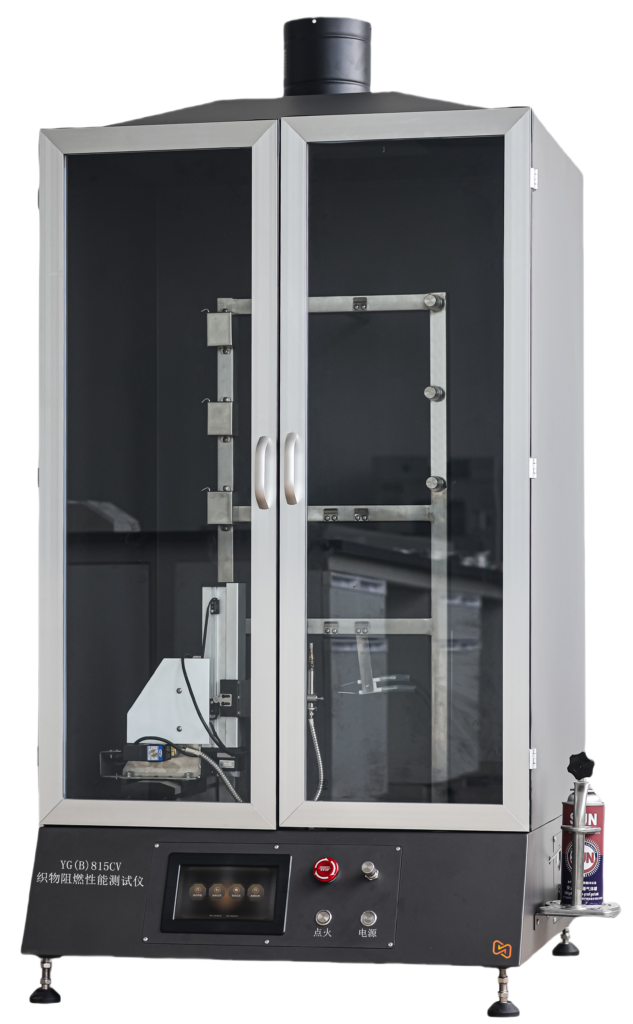
[Instrument Name]:Falmmability Test Chamber
[Scope of Application]:
Suitable for determining the vertical flame spread properties of textiles used in clothing, curtains/drapes, and large tents (including gazebos and awnings)—whether single-component or multi-component (e.g., coated, quilted, multilayer, or sandwich constructions)—to evaluate material performance upon flame contact under controlled laboratory conditions. It is also suitable for determining the vertical burning properties of automotive interior curtains, sunshades, and other hanging materials, evaluating parameters such as burn distance and burn time under controlled laboratory conditions.
[Test Modes]:
1. Evaluation of material or material combination performance upon flame contact under controlled laboratory conditions;
2. Determination of vertical burning properties for automotive interior curtains, sunshades, and other hanging materials;
3. Evaluation of burn distance and burn time for automotive interior materials or combinations upon flame contact under controlled laboratory conditions;
4. Combustion characteristic testing for protective clothing flame spread testers and welders’ protective gloves.
[Relevant Standards]: GB/T 5456, GB/T 8745, GB/T 8746, GB 32086, ISO 15025, ISO 6940, ISO 6941, EN 14878, etc.
[Technical Parameters]:
1. Burn position is fully adjustable; factory defaults are set to “bottom-edge ignition” or “surface ignition.”
2. Burner movement (horizontal, vertical, and angular) is controlled by three stepper motors.
3. Ignition time setting: 0–999.99 s; precision: 0.01 s.
4. Automatic recording of burn time: 0–999.99 s; precision: 0.01 s.
5. Automatic calculation of burn rate: 0–9999.99 mm/min; precision: 0.01 mm/min. 6. Flame height measuring device: 40 mm high scale, including markings for flame heights of 20 mm and 40 mm.
7. Specimen holder (3 types for different standards):
7.1: 560 mm × 170 mm rectangular frame
7.2: 200 mm × 160 mm rectangular frame
7.3: 200 mm × 80 mm rectangular frame
8. Marker thread: White mercerized cotton thread; linear density 45 tex–50 tex.
9. Specimen dimensions (depending on the standard):
9.1: 560 mm × 170 mm
9.2: 200 mm × 160 mm
9.3: 200 mm × 80 mm
10. Ignition gas: Industrial-grade propane or butane.
11. Combustion test chamber dimensions: L 902 mm × W 750 mm × H 1540 mm
12. Power supply: AC 220 V, 50 Hz, 150 W.
13. Weight: Approx. 80 kg
[Optional IoT Module Functions]:
1. Equipment status statistics: Displays the number of currently online devices.
2. Equipment alarm display: Shows the number and severity levels of current alarms.
3. Real-time experiment data and status/progress display: Includes active equipment, current data, experiment progress, and total experiment time.
4. Parameter configuration: Parameters can be set and sent directly to the instrument for modification, enabling bidirectional control between the instrument and the platform.
5. Map display: Shows the geographical location and status of various devices categorized by type.
6. Laboratory monitoring: Integrates surveillance cameras based on customer requirements to display real-time video feeds from the laboratory.
7. Customized unified management interface for laboratory equipment.
8. Temperature and humidity display: Integrates with third-party monitoring platforms to collect and display real-time environmental data (temperature and humidity) from the laboratory.
9. Supports device monitoring and alarm notifications via App and Web interfaces.
10. Supports customization of App name and logo.
11. Multi-account platform management: Supports multi-level permission settings and account allocation across different devices, departments, and subsidiaries. Facilitates centralized management for enterprises and enhances equipment data security.
12. Supports the submission of maintenance work orders, allowing manufacturers to easily review maintenance needs.
13. Supports data exchange via Ethernet (wired), Wi-Fi, and Bluetooth.
14. Capable of monitoring and managing multiple devices simultaneously.
15. Features large-capacity storage and analysis capabilities for test data.
16. Capable of outputting test data independently for each workstation.
17. Supports full-software OTA (Over-the-Air) updates for system evolution.