
Washing Color Fastness Tester
Model Number:SW-12AZ/24AZ
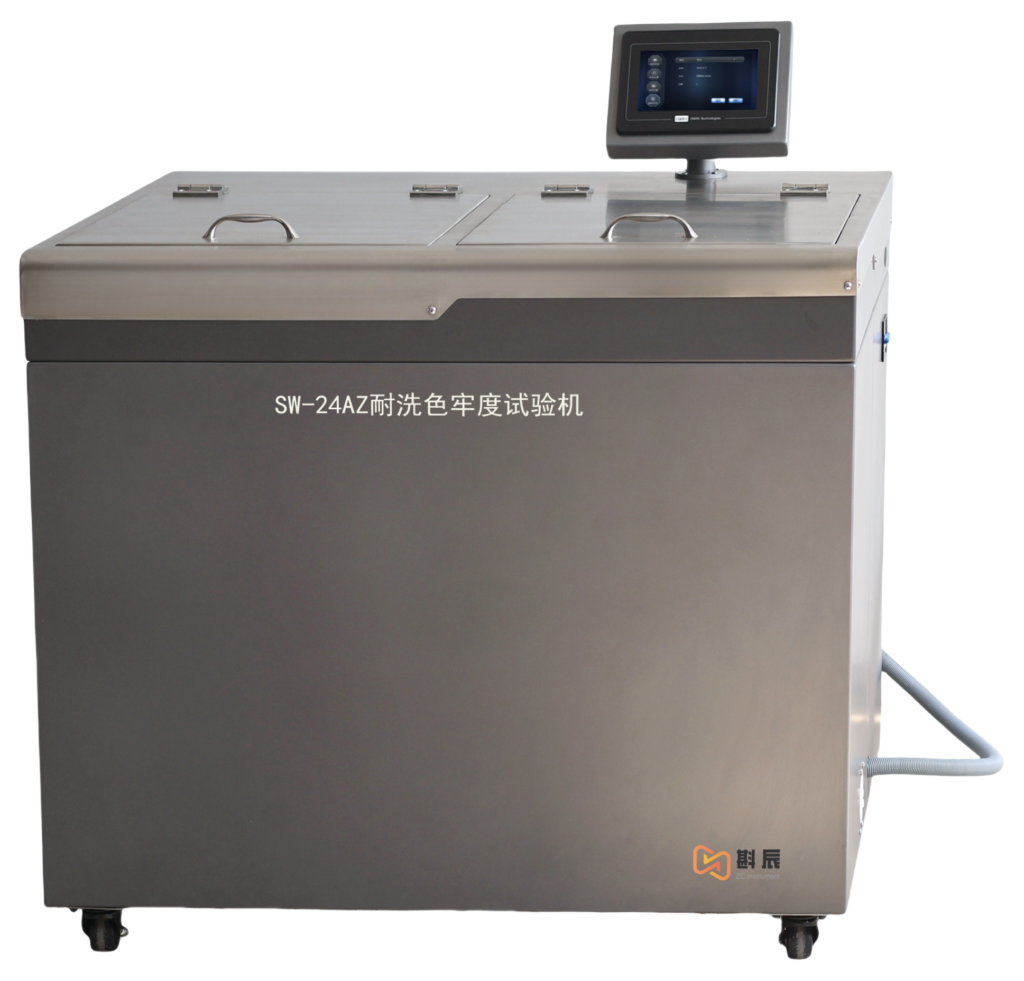
[Instrument Name]: Washing Color Fastness Tester
[3rd Lab Qualification Certificate]:
Tianfangbiao Certificate No.:TTTS-MCDT-FZ2512-04
[Patent number]:China Patent No.23342211
[Calibration Certificate]:Shanghai Branch of the National Textile Metrology Station Certificate No.:ZZ-202309889
[Drafting standard]:Enterprise StandardQ/WZC012-2026SW-12D
[Scope of Application]: It is used for testing the color fastness of various textiles to washing, dry cleaning, and milling; also used to evaluate the wash-fastness performance of dyes.
GB/T 3921-2008 “Textiles — Tests for colour fastness — Colour fastness to washing with soap or soap and soda”;
GB/T 5711-2015 “Textiles — Tests for colour fastness — Colour fastness to dry cleaning using tetrachloroethylene solvent”;
GB/T 12490-2014 “Textiles — Tests for colour fastness — Colour fastness to domestic and commercial laundering”;
AATCC 61/1A/2A/3A/4A/5A, JIS L0860/0844, BS 1006, ISO 105 C01/02/03/04/05/06/08, DIN, NF, CAN/CGSB, AS, etc.
[Instrument Features]:
1. Controlled via a 10-inch multifunctional color touchscreen for easy operation.
2. Features automatic water level control, automatic water intake and drainage, and dry-boil protection.
3. Equipped with a safety door switch to effectively prevent scalding and crushing injuries.
4. Uses an imported industrial microcontroller for temperature and time programming; incorporates PID (Proportional-Integral-Derivative) control to effectively prevent temperature overshoot and ensure timing accuracy within ±1s.
5. Uses solid-state relays to control heating elements; features no mechanical contacts, stable temperature, silent operation, and long service life.
6. Features multiple built-in standard programs for automatic operation via direct selection; supports program editing and storage, as well as individual manual operations, to accommodate various testing standards.
7. Test cup manufacturing quality far surpasses similar domestic products:
7.1 Molding process: Our company uses a single-piece die-casting process, whereas similar products use split-welded construction; the die-cast finish is smoother, flatter, and more aesthetically pleasing compared to the rough appearance of welded units.
7.2 Internal cup treatment: Our company employs a shot-blasting process, unlike the standard forging/casting used by competitors; this additional step densifies the steel structure for greater durability and creates an attractive, matte-like surface finish.
7.3 Cup material: Our company uses 316 stainless steel, while competitors typically use 201, 202, or 304 grades; the addition of molybdenum in 316 stainless steel provides superior corrosion resistance, making it particularly durable against seawater, acids, and alkalis.
7.4 Gasket material: Our company uses imported food-grade silicone, whereas competitors use black rubber or standard domestic silicone; the imported silicone offers better corrosion resistance, making it ideal for tests involving perchloroethylene, seawater, and chlorine bleaching agents.
7.5 Cup weight:Our cups weigh 630g (AATCC standard) and 394g (GB standard), compared to 538g and 342g for competing products; the heavier, thicker construction demonstrates the use of premium materials and ensures greater durability.
7.6 Compression spring material: Our company uses high-quality spring steel, while competitors use standard hard steel; spring steel provides a superior tactile feel—firm yet flexible—when opening and closing the cup, whereas standard hard steel feels stiff and harsh to the touch.
[Technical Specifications]:
1. Test cup capacity: 550ml (¢75mm × 120mm) — Suitable for GB, ISO, JIS, and other standards;
1200ml (¢90mm × 200mm) — AATCC Specifications (Optional)
2. Distance from rotating rack center to test cup bottom: 45 mm
3. Rotation speed: 40 ± 2 r/min
4. Timing control range: 9999 min 59 s
5. Timing control error: < ±5 s
6. Temperature control range: Ambient temperature to 100°C
7. Temperature control error: ≤ ±1°C
8. Heating method: Electric heating
9. Heating power: 5.5 kW
10. Water level control: Automatic water inlet and drainage
11. Display: 10-inch multifunctional color touchscreen
12. Heating power: Two sets (Left chamber: 4.5 kW; Right chamber: 4.5 kW)
13. Power supply: AC 380V, 50 Hz, 5 kW
14. Dimensions: 1000 mm × 750 mm × 1150 mm (L × W × H)
15. Weight: 150 kg
[Optional IoT Module Functions]:
1. Equipment status statistics: Displays the number of online and offline devices.
2. Alarm display: Shows the number and severity levels of current alarms.
3. Real-time test data and status/progress display (including the specific testing equipment). Displays real-time data, experiment progress, and total experiment duration.
4. Parameters can be set and sent directly to the instrument for modification, enabling bidirectional control between the instrument and the platform.
5. Map display: Shows the geographical locations and status of various devices based on device type.
6. Laboratory monitoring: Integrates surveillance cameras based on customer needs to display real-time video feeds from the laboratory.
7. Customized unified management interface for laboratory equipment.
8. Temperature and humidity display: Integrates with third-party monitoring platforms to collect and present real-time environmental data from the laboratory.
9. Supports device monitoring and alarm notifications via both App and Web interfaces.
10. Supports customization of the App name and logo.
11. Multi-account platform management: Allows for multi-level permission settings and account allocation across different devices, departments, and subsidiaries, facilitating unified enterprise management and enhancing device data security.
12. Supports maintenance work order submission, allowing manufacturers to view and manage maintenance requests.
13. Supports data exchange via Ethernet (wired), Wi-Fi, and Bluetooth.
14. Capable of monitoring and managing multiple devices simultaneously.
15. Features large-capacity storage and analysis capabilities for test data.
16. Supports full-software OTA (Over-the-Air) updates for device evolution.
[Standard Configuration]:
The 12AZ model features a “working chamber + preheating chamber” structure; users can choose between configurations A and B:
A: Left working chamber with 12 ISO standard cups (550ml) + Right preheating chamber.
B: Left working chamber with 6 AATCC cups (1200ml) + Right preheating chamber.
The 24AZ model features a “working chamber + working chamber” structure; users can choose between configurations A, B, and C:
A: Left working chamber with 12 ISO standard cups (550ml) + Right working chamber with 12 ISO standard cups (550ml).
B: Left working chamber with 6 AATCC standard cups (1200ml) + Right working chamber with 6 AATCC standard cups (1200ml).
C: Left working chamber with 12 ISO standard cups (550ml) + Right working chamber with 6 AATCC standard cups (1200ml).