
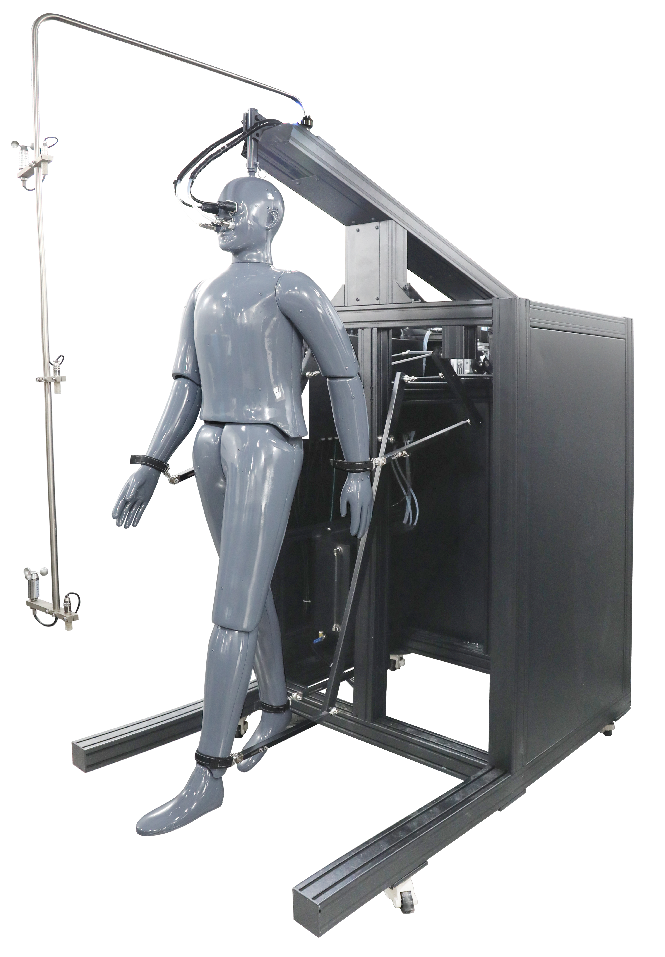
[Instrument Name]:Sweating Thermal Manikin Test System
[Drafting standard]:Enterprise Standard Q/WZC007-2026:
[Scope of Application]: Realistic simulation and comprehensive testing of the thermal and moisture comfort performance of garments.
[Test Modes]:
* **Thermal Resistance:** Simulates the heat exchange process among the human body, the garment, and the environment. It calculates thermal resistance based on the relationship between physical parameters—such as the temperature difference between the manikin’s skin surface and the environment, and the non-evaporative heat loss rate per unit area of the body surface.
* **Moisture Resistance:** Under specified temperature, humidity, and wind speed conditions, the garment is worn by a sweating thermal manikin (in either a standing or walking posture). Moisture resistance is calculated by measuring the manikin’s power consumption or the evaporation rate of liquid water transmitted through the garment.
[Brief Introduction]:
Accurately and comprehensively evaluating the heat and moisture transfer performance of garments—and simulating the heat and moisture exchange process of the human-garment system—has long been a challenge for the industry. Current market standards and instruments for testing thermal and moisture resistance primarily focus on textile fabrics. However, a garment’s thermal and moisture performance depends not only on the fabric but also on design, structure, and manufacturing processes. Furthermore, sweat rates vary across different parts of the human body; relying solely on fabric testing cannot fully assess the thermal insulation and moisture permeability of finished garments.
The sweating thermal manikin testing technology developed by our company employs the internationally recognized optimal method for objectively evaluating the overall thermal and moisture resistance of garments. It is widely used in sectors such as apparel, aerospace, firefighting, the petroleum industry, traffic safety, and occupational health. It plays a particularly vital role in evaluating thermal insulation performance, researching insulation mechanisms, and developing occupational protective clothing. This technology is considered essential, state-of-the-art equipment for research in clothing ergonomics, representing a cutting-edge intersection of clothing science, human biomimetics, and biophysics.
[Design Principles]:
1. **Thermal Resistance:** The basic principle for testing garment thermal resistance using a thermal manikin involves simulating the heat exchange process among the human body, the garment, and the environment. The value of the garment’s thermal resistance is derived from the relationship between physical parameters, such as the temperature difference between the manikin’s skin surface and the environment, and the non-evaporative heat loss rate per unit area of the body surface. 2. Moisture Vapor Resistance: The basic principle behind testing the moisture vapor resistance of clothing is to simulate the clothing’s moisture transmission performance when the human body sweats, whether in a stationary or active state.
[Relevant Standards]:
GB/T 39605-2020 “Test method for moisture vapor resistance of clothing—Sweating thermal manikin method”
GB/T 18398-2001 “Test method for thermal resistance of clothing—Thermal manikin method”
GB/T 38426-2019 “Determination of thermal resistance and usage temperature of sleeping bags”
ISO 15831 “Clothing—Physiological effects—Measurement of thermal insulation by means of a thermal manikin” (All the above standards must meet the latest requirements)
ASTM F 1291 “Standard Test Method for Measuring Thermal Insulation of Clothing Using a Heated Manikin”
ASTM F 1720 “Standard Test Method for Measuring Thermal Insulation of Sleeping Bags Using a Thermal Manikin”
ASTM F 2370 “Standard Test Method for Measuring the Evaporative Resistance of Clothing Using a Sweating Manikin”
EN 342:2017 “Protective clothing—Ensembles and garments for protection against cold (CE-PPE certification standard),” etc.
[System Structure/Components]: (Figure 1)
The system comprises a manikin, a motion control system, a data acquisition and transmission system, an airflow velocity control system, a temperature/humidity and airflow velocity testing system, a walk-in climate chamber, and a centralized system control and computer software application platform. The manikin assembly includes subsystems such as the sweating manikin itself, a sweating system, a temperature control system, and an overheat safety protection system.
1. Walk-in climate chamber 2. Centralized system control and computer software application platform 3. Motion control system
4. Temperature/humidity and airflow velocity testing system 5. Manikin 6. Data acquisition and transmission system
7. Airflow velocity control system
[Manikin]: (Figure 2)
1. The manikin has a height of 1.7 ± 0.15 m and a body surface area of 1.8 ± 0.3 m². The model fully simulates a real human body and is equipped with shoulder, elbow, and hip joints. The knee and ankle joints allow the mannequin to assume various poses, enabling a more realistic simulation of clothing’s thermal and moisture resistance across a full range of body postures.
2. The mannequin is divided into 34 independent heating zones, each equipped with its own temperature control, sweating, and data acquisition systems. This configuration supports both full-body and localized clothing testing.
3. The temperature control system utilizes high-precision digital temperature sensors paired with heating films that are evenly distributed and closely fitted to the mannequin’s surface.
4. The sweating system employs a high-precision imported delivery mechanism, allowing for independent control of sweating rates in each zone.
5. Three measurement modes are available—constant heat, constant temperature, and variable temperature—designed to observe variations in heat dissipation across different parts of the garment, measure thermal and moisture resistance, and simulate physiological skin changes under varying environmental conditions.
6. The data acquisition system utilizes RS485 communication to capture real-time test data from the environment and the mannequin at high frequencies.
[Motion System]: (Figure 3)
1. The thermal mannequin supports three postures: static standing, static lying (supine), and dynamic walking. The static lying posture is primarily used to test the thermal resistance of quilts and sleeping bags, while the static standing and dynamic walking postures are used for clothing testing.
2. The motion control system features an external connection design, allowing for easy switching between static and dynamic testing modes. The main frame is constructed from high-strength aerospace-grade aluminum profiles, and the motion mechanism is driven by servo motors, enabling precise setting and control of the mannequin’s movements and range of motion.
[Temperature, Humidity, and Wind Speed Testing System]: (Figure 4)
Three ambient temperature sensors, three ambient humidity sensors, and two ambient wind speed sensors are positioned around the thermal manikin. These sensors are placed at a distance of 0.5 m from the manikin at staggered heights; a rotating mechanism allows the sensors to be moved aside during manikin setup and dressing. Sensor accuracies are as follows: temperature better than 0.2°C, humidity better than 5%, and wind speed better than 0.05 m/s.
[Wind Speed Control System]: An application program controls a variable-frequency motor to generate wind speeds ranging from 0 to 8 m/s within the test environment. (Figure 4)
[Centralized System Control and Software Application Platform]: (Figure 5)
The centralized control and software application platform features an all-stainless steel housing; all electrical components are centrally mounted to facilitate installation, commissioning, and maintenance.
 The software application system is user-friendly and supports functions such as thermal control, fault monitoring, system parameter configuration and calibration, real-time data display and recording, and intuitive presentation of test results.
(Figure 1)


(Figure 2)

(Figure 3)


(Figure 4)


(Figure 5)
[Instrument Features]:
1. The model faithfully replicates the human form and features articulated joints—such as the shoulders, elbows, and knees—enabling the simulation of walking movements and a more realistic assessment of a garment’s thermal and moisture resistance under actual body postures;
2. It comprises 34 independent heating zones, each equipped with its own temperature control, sweating, and data acquisition systems, allowing for both whole-body and localized garment testing;
3. The temperature control system utilizes high-precision point-type temperature sensors positioned in close contact with the heating elements, which are evenly distributed across the mannequin’s surface;
4. The sweating system employs high-precision imported delivery mechanisms, enabling independent control of sweat rates for each zone;
5. The data acquisition system uses RS485 communication to capture real-time test data—from both the environment and the mannequin—at high frequencies;
6. The thermal mannequin supports three postures: static standing, lying flat, and dynamic walking. The static lying posture is primarily used for testing the thermal resistance of quilts and sleeping bags, while the static standing and dynamic walking postures are used for garment testing;
7. The operation control system features an external connection design, allowing for easy selection between static and dynamic testing modes. The main frame is constructed from high-strength aerospace-grade aluminum profiles, and the drive mechanism utilizes servo motors to precisely set and control the mannequin’s movements and range of motion;
8. An independent wind speed control system provides the various airflow velocities required for testing;
9. The centralized control platform features an all-stainless steel structure with all electrical components centrally mounted, facilitating installation, commissioning, and maintenance;
10. The proprietary software system is user-friendly and supports functions such as thermal control, fault monitoring, system parameter configuration and calibration, real-time data display and recording, and intuitive presentation of test results. [Technical Specifications]:
(I) Sweating Thermal Manikin
1. Manikin size: 1.75 ± 0.15 m;
2. Manikin surface area: 1.8 ± 0.3 m²;
3. Number of zones: 34;
4. Number of temperature sensors: 37;
5. Peristaltic pump precision: 25 µL/stroke;
6. Maximum temperature difference between adjacent zones: 3°C;
7. Weight: Approx. 50 kg;
8. Power supply: AC 220V;
9. Temperature resolution: 0.1°C; temperature measurement accuracy: 0.2°C;
10. Maximum output power: 1200 W/m²;
11. Power measurement accuracy: ±2%;
12. Sweating rate: 400 – 1000 ml/(m²·h);
13. Thermal resistance range: 0.6 – 6.5 clo;
14. Thermal manikin accuracy: Thermal resistance value measured under reference conditions: (0.78 ± 0.03) clo;
15. Thermal manikin repeatability: Coefficient of variation for results of 3 repeated tests on the same matching clothing set is ≤3%;
16. Thermal manikin reproducibility: Coefficient of variation for test results of the same clothing across different laboratories is ≤8.5%;
17. Measurement sampling frequency: 10 times/minute;
18. Walking steps: Default 45 ± 2 steps/minute (adjustable 30–60 steps), stride length 63 ± 10 cm;
19. Arm swing: Default 45 ± 2 swings/minute (adjustable 30–60 swings), swing amplitude 53 ± 10 cm;
20. Postures: Standing, lying down, or dynamic; Feet: 45 ± 2 steps/min; Arms: 45 ± 2 swings/min; Stride length: 63 ± 10 cm; Arm swing amplitude: 53 ± 10 cm;
(II) Motion Simulation Control System
1. Thermal manikin supports stationary standing. …three postures: lying flat, standing still, and dynamic walking. The static lying-flat posture is primarily used to test the thermal resistance of quilts and sleeping bags, while the static standing and dynamic walking postures are used for testing garments;
2. The motion control system utilizes an external connection design, allowing for easy selection between static and dynamic testing modes. The main frame is constructed from high-strength aerospace-grade aluminum profiles, and the motion mechanism is driven by servo motors, enabling precise setting and control of the mannequin’s movements and range of motion;
3. The testing platform is utilized for the static lying-flat posture.。

(III). Walk-in climate chamber (optional equipment):
1. Internal dimensions (minimum): (4 × 4 × 3) m³;
2. Footprint dimensions: 4.5 m × 5.5 m (installation space required: at least 7.5 m (L) × 7.5 m (W) × 3.5 m (H));
3. Operating temperature range: -20°C to 50°C (pre-heating of the manikin is required for sub-zero environments where icing may occur);
4. Temperature measurement and setting accuracy: ±0.2°C;
5. Operating humidity range: 15% to 95% RH;
6. Humidity measurement accuracy: ±5%;
7. Operating wind speed range: (0.15 to 8) m/s; Note: This refers to the external wind speed relative to the manikin; the internal airflow velocity of the chamber itself must not exceed 0.1 m/s.
8. Wind speed measurement accuracy: ±0.05 m/s;
9. Power supply: 380 V AC (±10%), 50 ± 0.5 Hz, 45 kW.
[Test Procedures]:
1. Thermal resistance
1.1. Prepare the garment to be worn by the manikin.
1.2. Prior to the experiment, condition the test garment for 12 hours at a temperature of (20 ± 5)°C and a relative humidity of (50 ± 20)%.
1.3. Dress the manikin in the test garment and begin testing; once the thermal manikin reaches dynamic thermal equilibrium, maintain this state for at least 20 minutes.
1.1.1. Set parameters, including ambient temperature and humidity, wind speed, walking speed (steps), and manikin body temperature;
1.1.2. Activate the climate chamber and the manikin’s temperature control system;
1.1.3. Wait for the climate chamber to stabilize and the manikin to reach thermal equilibrium, then measure the manikin’s “naked” thermal resistance over a 30-minute test period;
1.1.4. Dress the manikin in the garment;
1.1.5. Wait for the climate chamber to stabilize and the manikin to reach thermal equilibrium;
1.1.6. Measure the total thermal resistance of the manikin wearing the garment. Test for 30 minutes;
1.1.7. Calculate the basic thermal resistance of the garment;
1.1.8. Change the garment and restart from step 1.1.4.
1.1.9. Conclude the thermal resistance test and report the test data.
2. Evaporative Resistance
2.1. Refer to section 1.1.
2.2. Before measuring the evaporative resistance of the garment, first measure the total thermal resistance of the garment by following the thermal resistance test procedure;
2.3. Configure parameters, including ambient temperature and humidity, wind speed, number of steps, water supply temperature, and body temperature;
2.4. Wait for the climate chamber conditions to stabilize, then humidify/wet the manikin’s skin until the surface reaches a state of moisture saturation;
2.5. Set the sweating rate for the sweating thermal manikin and activate the sweating function;
2.6. Wait for the manikin to reach thermal equilibrium, then measure the evaporative resistance of the manikin in its nude state;
2.7. Dress the manikin in the test garment;
2.8. Wait for the manikin to reach thermal equilibrium, then begin measuring and recording experimental data for at least 30 minutes; calculate the average measured value and the total evaporative resistance of the garment;
2.9. Change the garment and restart from step 2.7.
[Standard Configuration]:
Item | Name | Qty | Remark |
1 | Test chamber | 1Set | Optional |
2 | Chamber Environmental Temperature and Humidity Data Acquisition System | 1Set | Optional |
3 | Chamber Wind Speed Control and Testing System | 1Set | Optional |
4 | Manikin Motion Mount and Control System | 1Set |
|
5 | Sleeping Bag Test Rig | 1Pcs |
|
6 | 34-zone sweating thermal manikin | 1Pcs |
|
7 | Sweat thermal regulation and transport system for thermal manikins | 1Set |
|
8 | System Console | 1Pcs |
|
9 | High-performance laptop | 1Set |
|
10 | Computer operating software and data acquisition and analysis system | 1Set |
|
11 | Far-infrared thermal imager | 1Set |
|
12 | Skin suit for sweating manikin testing | 2Set |
|
[Testing site]:

Application Scenarios

Sample testing scenario

Sleeping bag testing scenarios