
QUV UVA/UVB Aging Chamber
Model Number of YG(B)611QUV-II
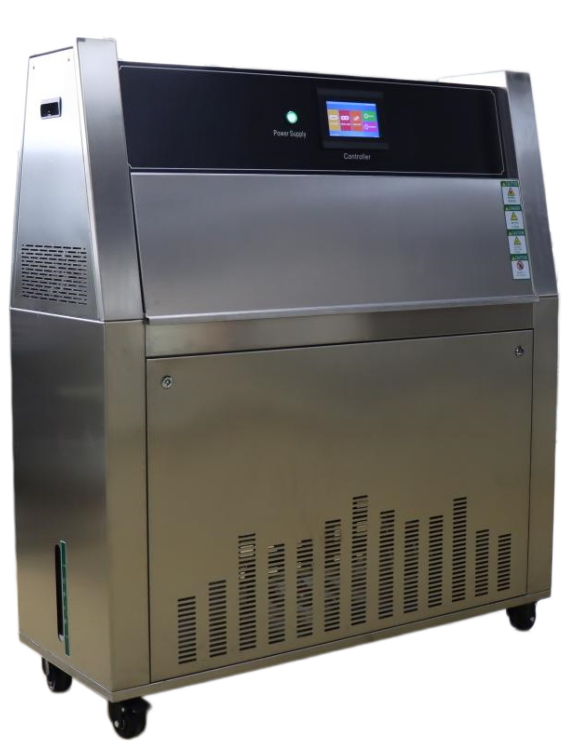
[Instrument Name]: QUV UVA/UVB Aging Chamber
[Scope of Application]:
Sunlight and moisture in the natural environment cause material degradation, resulting in incalculable economic losses annually. The UV accelerated weathering tester reproduces the damage caused by sunlight, rain, and dew. Testing is conducted by subjecting the material to controlled, alternating cycles of sunlight and moisture while simultaneously elevating the temperature. The equipment uses fluorescent UV lamps to simulate sunlight and reproduces moisture effects through condensation or water spray. It can replicate damage in just a few days or weeks that would otherwise take months or years to occur outdoors. Typical forms of damage include fading, discoloration, loss of gloss, chalking, cracking, hazing, embrittlement, loss of strength, and oxidation. The test data provided is invaluable for selecting new materials, improving existing ones, or evaluating how changes in composition affect product durability. The equipment effectively predicts the changes a product will undergo during outdoor exposure.
[Test Modes]:
UV Weathering Test Chamber: An accelerated aging test device and the most widely used equipment for accelerated aging assessment. While the UV light in the chamber does not simulate the full solar spectrum, the short-wave UV range (300–400 nm) is the primary cause of aging and degradation for durable materials exposed outdoors. As evidenced by its operating principle, the chamber effectively simulates sunlight in the short-wave UV region—specifically from 365 nm down to the shortest wavelengths found in natural sunlight.
[Relevant Standards]:
GB/T14522-2008
ISO4892-3:1994 Standard requirements
GB/T8427-1997(Color fastness to artificial light: UV) Equivalent to IS0105-B02
GB/T8430-1997(Color fastness to artificial weathering: UV) Equivalent toIS0105-B04
GB/T14576-1997(Test method for combined color fastness of textiles to light and perspiration)
AATCC16 JIS 0843 SAE 2020, PREN 1062-4, ISO4892-3, ASTM G53, EN 543, ISO 11507
[Equipment Features]:
This testing system features an advanced structural design and a rational mechanical layout; it is manufactured using standardized processes throughout, resulting in a neat and aesthetically pleasing appearance. Key functional components utilize genuine parts from internationally renowned brands, ensuring stable operation through mature, advanced control technology while achieving an optimal balance between quiet performance and energy efficiency; its comprehensive technical specifications rival those of high-end equipment from overseas. The system boasts excellent component compatibility and assembly precision, with core functional units employing world-class, genuine imported parts; this effectively enhances operational safety and long-term reliability, fully supporting the user’s need for continuous, high-frequency testing operations.
1. Large color touchscreen display featuring multiple visualization modes (animations, numerical data, charts, etc.) for real-time monitoring of the test chamber’s operating status.
2. Controlled by a high-performance industrial-grade microcontroller (U7400 V26) with strong anti-interference capabilities.
3. Utilizes advanced circuitry technology; no dedicated voltage stabilizer is required.
4. Features a light-shaping system that allows for flexible specimen placement, ensuring uniform light exposure across all samples.
5. Equipped with a high-power refrigeration system within the chamber, enabling precise temperature control over a wide range (refrigeration system is an optional accessory).
6. Uses an imported ultrasonic atomizer to strictly control droplet size, producing a fine, uniform mist with silent operation (optional).
7. Dual-circuit electronic redundancy design ensures continuous, trouble-free operation over extended periods.
8. Open programming design allows users to configure custom operating programs to meet specific testing standards.
9. Includes fault alerts and self-diagnostic functions with multi-point monitoring (temperature, humidity, fan, UV source, lamps, and chamber door) to facilitate maintenance and ensure proper operation.
10. Displays dynamic compensation curves for temperature and humidity.
11. Built-in water reservoir connects to the mains supply with automatic water level control and filtration to prevent pump burnout or atomizer clogging due to water shortage.
[Technical Specifications]:
1. Lamps: 8 x UV lamps (UVA type)
2. Temperature Range: Ambient +10°C to 70°C
3. Lamp Lifespan: Guaranteed for over 5,000 hours
4. Spectral Wavelength: UVA340 wavelength: 295–365 nm /UVB313 Wavelength: 280–313 nm
5. Temperature range: UV aging standards do not specify a temperature requirement; humidity is used solely to simulate morning dew condensation (this is an optional feature) and serves no other purpose. Our UV aging chambers operate in an energy-saving mode at 50%–70% humidity.
6. Simulation cycle: Adjustable from 0 to 10,000 minutes
7. Spray duration: Adjustable from 0 to 10,000 minutes
8. Power supply: AC 220V/50Hz; total power 3 kW
9. Lamp power: 40 W; lifespan: 1,200 hours
10. Irradiance: (280–400 nm) 0.5 W/m² (irradiometer is optional)
11. Ballast/Starter power: 40 W; operating voltage AC 220V; current 0.18 A
12. Temperature range: (Ambient +10°C) to 80°C
13. Test black panel temperature: 63°C ± 3°C / 83°C ± 3°C
14. Humidity range: 50% ± 5% (natural humidity)
15. Temperature uniformity: ≤3°C
16. Rain cycle: Spray 18 min, pause 102 min OR spray 12 min, pause 48 min (fully programmable)
17. Water spray pressure: 78–127 kPa
18. Controller: TEMI880 V2.0 programmable controller with large touchscreen interface
19. Power & Water requirements: Voltage: 220V ± 10%, 50/60Hz, 20A, 3 kW
20. Cooling water: Manual and automatic water inlet options
21. Internal circulation water: Distilled or clean water used for humidification, rain simulation, etc. (Rainwater system can be configured to withstand strong acid/alkali solutions based on user requirements—optional configuration)
[Chamber Structure]:
1. Structural design: For certain applications, water spraying better simulates actual end-use environmental conditions. Water spray is extremely useful for simulating mechanical erosion caused by sudden temperature changes and rainfall. Roofing materials, automotive components, and coatings used on metal structures are frequently subjected to rapid temperature fluctuations—such as when heat accumulated during a hot summer day is suddenly dissipated by a heavy rainstorm. Coping with such temperature shocks poses a challenge for many materials. The UV Accelerated Weathering Tester (Spray Type) is specifically designed to replicate these conditions.
2. Outer casing material: Cold-rolled steel sheet with powder-coated finish
3. Inner chamber material: Stainless steel
4. Control panel: Controller unit
5. Chamber lid material: Exterior powder-coated finish; interior SUS304 stainless steel
6. Mobility system: Lockable/movable high-load-bearing PU casters
7. Light source: Total of 8 UV lamps installed (left and right sides)
8. Heating method: Water bath heating in the inner chamber; rapid temperature rise and uniform temperature distribution
9. Chamber door: Left-opening, recessed design for smooth and easy operation
10. Inner chamber water level: Automatic water replenishment to prevent damage to heating elements from dry firing
11. Specimen rack: Stainless steel construction
12. Drainage system: Vortex-type and U-trap drainage mechanism
13. Specimen surface: Parallel to the plane of the UV lamps
14. Leveling/positioning device: Ensures stable operation of the test chamber
15. Spray system: Internal automatic spray nozzles with adjustable water pressure
[Heating System]
1. Heating system: Temperature control operates independently of the light source. Output power is calculated by a microcomputer to ensure high precision and energy efficiency. Uses U-shaped titanium alloy high-speed heating elements.
2. Black panel temperature control: Intelligent Korean temperature controller; output power calculated by microcomputer with PID auto-tuning. Monitoring utilizes a standard Pt-100 black panel temperature sensor.
3. Temperature control instrumentation: Uses PID + SSR control with synchronized system channel coordination to enhance the stability and lifespan of control components and interfaces. Features touch-screen settings and digital direct display. Features automatic PID calculation capabilities, reducing the inconvenience associated with manual settings. Illumination and condensation functions can be controlled independently or via alternating cycles; the duration for both independent and cyclic modes can be set arbitrarily up to 1,000 hours. Warning signals are issued in the event of errors during operation or setup. Utilizes Schneider (France) components, as well as Philips ballasts and starters (ensuring reliable UV lamp ignition upon startup).
[Light Source System]:
1. UV Fluorescent Lamp Source: A total of eight 40W lamps distributed on the left and right sides of the unit. Users can choose between UVA-340 and UVB-313 light sources. To mitigate the impact of gradual UV energy decay over time, the chamber employs a staggered replacement strategy: one old lamp is replaced with a new one at intervals of one-quarter of the lamp’s service life (rated at 5,000 hours). This ensures the UV source always consists of a mix of new and old lamps, thereby maintaining a constant light energy output.
2. UV and Sunlight Simulation: Although ultraviolet (UV) radiation accounts for only 5% of sunlight, it is the primary light-related factor causing durability degradation in outdoor products. This is because the photochemical effects of sunlight intensify as the wavelength decreases. Consequently, reproducing the full solar spectrum is unnecessary when simulating the damaging effects of sunlight on a material’s physical properties; in most cases, simulating short-wave UV light is sufficient.
3. UV-A Lamp: Defined as a fluorescent UV lamp that emits less than 2% of its total optical energy at wavelengths below 300 nm; the wavelength range is 315–400 nm, with peak spectral energy concentrated at 340 nm.
4. UVA-340: The optimal choice for simulating solar UV radiation; it effectively replicates the solar spectrum in the critical short-wave range (295–360 nm) and emits only UV wavelengths found in natural sunlight.
5. UV-B Lamp: Defined as a fluorescent UV lamp that emits more than 10% of its total optical energy at wavelengths below 300 nm; the wavelength range is 280–315 nm, with peak spectral energy concentrated at 313 nm.
6. UVB-313: Used for highly accelerated testing to yield rapid results. These lamps utilize short-wave UV radiation that is more intense than the UV light typically found on Earth. While this short-wave UV significantly accelerates testing, it can also cause unrealistic degradation in certain materials.
[Safety Protections]:
1. Chamber Opening Protection: If the test chamber door is opened, the machine automatically cuts off power to the lamps and enters a cooling/stabilization mode to prevent personal injury.
2. Protective Devices: Includes over-temperature protection, over-current protection, low-water protection, fuse protection, UV leakage protection, overload protection, earth leakage protection, fully insulated terminals, automatic shutdown, and other safety features.