
Martindale Pilling and Abrasion Tester
Model Number of YG(B)401GT
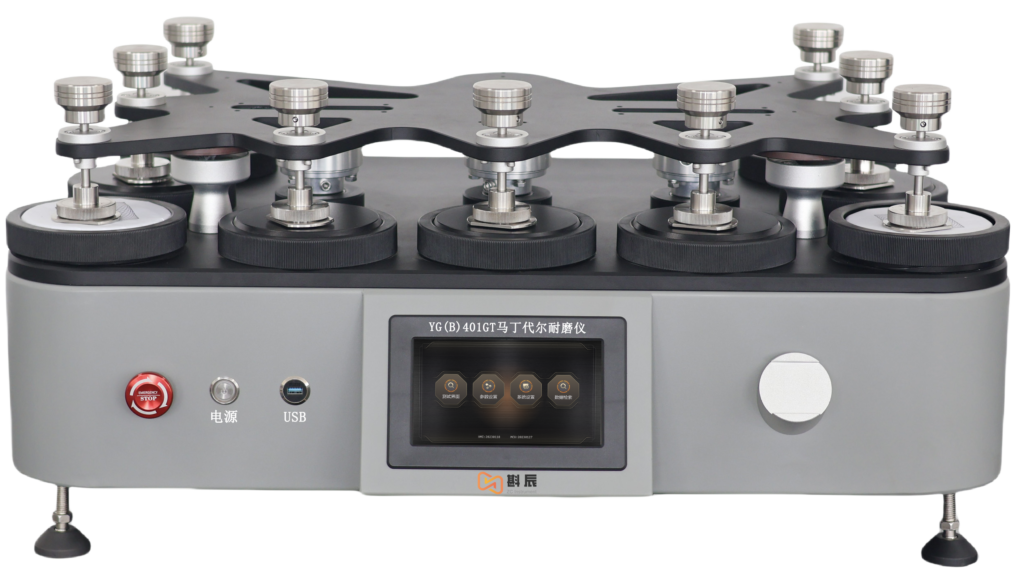
[Instrument Name]: Martindale Pilling and Abrasion Tester
[Certificate of Honor]: China National Textile and Apparel Council (CNTAC) “Light of Textiles” 2025 Textile Industry Collaborative Project for the Promotion of Specialized, Refined, Distinctive, and Innovative (SRDI) New Products and Technologies; Project No.: XJS25178.
[3rd Lab Qualification Certificate]:
Tianfangbiao Certificate No.:TTTS-MCDT-FZ2403-01
[Patent number]:China Patent No.:23346944
[Drafting standard]:Enterprise Standard Q/WZC010-2026
[Scope of Application]:
It is used for textiles and membrane materials to test abrasion resistance, wear characteristics, and changes in appearance (such as pilling) using the Martindale method.
[Relevant Standards]:
GB/T 21196, FZ/T 20020, GB/T 4802.2, GB/T 13775, ASTM D4966, ASTM D4970, ASTM D3886, ISO 12945-2, ISO 12947, JIS L1096, IWS TM196/TM112, M&S, etc.
[Instrument Features]:
- Speed is digitally adjustable between 20 and 70 rpm.
- Optional IoT module available, supporting remote monitoring and alarms, usage logging, and firmware upgrades.
- Voice prompts for standby and operating status (e.g., running, fault, completion).
- Integrated with common test standards and customizable programs.
- Customizable ball-plate abrasion testing function (ISO 17076-2, GB 39057).
- Three test modes and two counting methods (increment/decrement); independent counting for each testing station.
- Flip-free guide plate design; no need to move the assembly when loading samples.
- PLC modular control with an 8.8-inch color touchscreen; bilingual menu (Chinese/English).
- AC servo drive ensures low noise and strong anti-interference capability.
- Electronic leveling device displays the horizontal offset angle, helping to minimize testing errors.
- Optional barcode scanner and standard network communication module.
- Optional standard API interface supports real-time data transmission with LIMS, automated workflows, and cross-system integration.
[Optional IoT Module Functions]:
- Equipment status statistics: displays the number of online and offline devices.
- Equipment alarm display: shows the number and severity level of active alarms.
- Real-time test data and status/progress display, including details on the testing equipment. Real-time data, experiment progress, and total experiment duration
- Parameters can be set and sent directly to the instrument for modification, enabling bidirectional control between the instrument and the platform
- Map display: Shows the geographical locations and status of various devices based on device type
- Laboratory monitoring: Integrates surveillance cameras based on client needs to display real-time video feeds from the laboratory
- Customized unified management interface for laboratory equipment
- Temperature and humidity display: Integrates with third-party monitoring platforms to collect and present real-time environmental data from the laboratory
- Supports device monitoring and alerts via both mobile app and web interfaces
- Supports customization of the app name and logo
- Multi-account platform management: Supports multi-level permission settings and account allocation across different devices, departments, and subsidiaries, facilitating unified enterprise management and enhancing device data security
- Supports maintenance work order submission, allowing manufacturers to review and manage maintenance tasks
- Supports wired Ethernet connectivity. Wi-Fi and Bluetooth data exchange
- Capable of monitoring and managing multiple devices simultaneously
- Capable of storing and analyzing large volumes of test data
- Capable of outputting test data independently for each station
- Supports full-software OTA (Over-the-Air) system upgrades
[Technical Parameters]:
- Number of stations: 9
- Count display:
- Preset count: 0–999,999 cycles
- Cumulative count: 0–999,999 cycles
- Maximum stroke: 24 ± 0.5 mm, 60.5 ± 0.5 mm
- Mass of pressure weights:
- Weight for fabric specimens: 397 ± 2 g
- Weight for furniture upholstery specimens: 597 ± 2 g
- Stainless steel disc: 260 ± 1 g
- Effective mass and friction diameter of holders:
Type A: 198 g (3 kPa) friction head, φ 28.5 ± 0.05 mm
Type B: 155 g (1.52 N) friction head, φ 90 mm
- Relative motion speed between holder and abrasion table: (50 ± 0.5) r/min (adjustable 20–70 r/min)
- Mass of sample mounting weight: 2385 ± 10 g
- Dimensions: 870 × 580 × 400 mm (L × W × H)
- Weight: 73 kg
10. Power supply: AC 220 V ± 10%, 50 Hz, 200 W